Burnt Electrical Smell: What It Means and What to Do
A hot, plasticky or fishy smell near your wiring is one thing you should never sniff and shrug off.
Below is what that smell tends to mean, the safe steps to take in the next few minutes, and how we track the heat down and make it right.
Strong smell right now? Ring (02) 9073 7836 straight away, at any hour.
What a Burnt Electrical Smell Actually Means
Somewhere in the system heat has built past a safe level, and that smell is the first warning it gives you.
Electrical insulation and plastic fittings give off a sharp, acrid odour as they cook. A faint fishy or metallic note usually means a component itself is overheating rather than an appliance.
The heat is often somewhere you cannot see it. Inside a wall cavity, up in the ceiling, or deep in the switchboard, a connection can be quietly warming long before anything scorches on the surface.
That hidden quality is exactly why a smell with no obvious source deserves a proper look, not a guess.
The Most Likely Causes
Working from the causes we meet most down to the rarest, here is what tends to be behind it.
- A slack or corroded terminal. Where a joint is not tight, resistance climbs at that point, and that resistance is what you end up smelling as heat.
- Insulation breaking down. Perished rubber or cloth-covered cable in an untouched older home cooks and gives off that acrid note.
- An ageing fuse board under load. Old carriers run hot and arc, especially once a household draws more than the board was ever built for.
- An overloaded circuit. More current drawn than the cable was ever rated to carry, so the run heats up over its whole length.
- A failing appliance or its lead. An internal fault can cook the plug, the flex or the point it plugs into.
- Moisture reaching a connection. Damp getting into a fitting causes it to arc and overheat.
How Serious Is It?
Treat any genuine burning smell as urgent. This is one of the few faults where we skip the caveats.
A burning smell means heat has already built up somewhere in a circuit, a point or the board. Leave it and that heat can move on to scorching, melted insulation, or a fire.
Holding it safe until we arrive is straightforward. Switch off the circuit that seems to be the source, drop the main switch if you cannot tell which one it is, and keep clear of that room.
If you can see smoke, a flame or sparks, get everyone out and call 000 first, then call us.
Three Safe Steps To Take Now
Keep it to these. Anything past isolating the power is our job, not yours.
- Cut the power first. Flip the circuit you suspect, and reach for the main switch instead when nothing points to an obvious source.
- Unplug the obvious suspect if one is clearly hot or smelling, without touching anything that feels warm.
- Ring (02) 9073 7836 and describe the smell. We will tell you whether it can wait until morning or needs someone tonight.
How We Fix It, Step by Step
We treat a burnt smell as a fault-finding priority the moment we arrive, because the source is usually hidden.
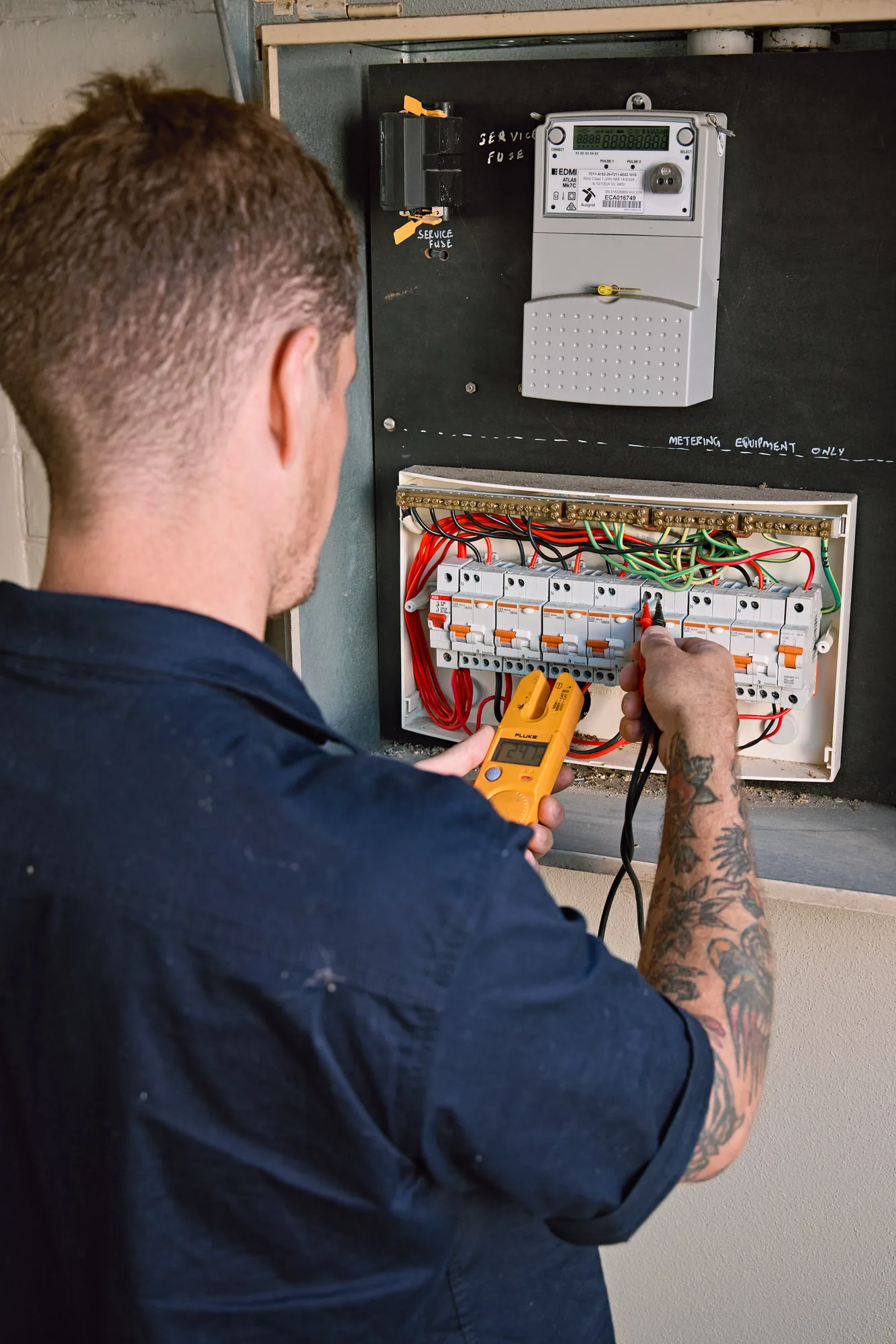
First we isolate and test, checking the switchboard and each fitting that might be running hot. Thermal imaging and insulation testing let us pinpoint the trouble without pulling half the house apart.
Once it is located, the repair follows what we found. A slack terminal gets re-terminated, a cooked length of cable gets renewed, or an old board gets brought to standard when fuse wire is the underlying cause.
Guessing at a smell is not fixing it, so we nail down the real cause before signing off. Notifiable work leaves you with a compliance certificate, plus a plain-English account of what was going on.
Why Dulwich Hill's Housing Makes This Common
Much of Dulwich Hill's older housing still runs wiring and boards from an era long before modern circuit protection.
Untouched Federation and inter-war homes here can still carry perished rubber-insulated cabling that breaks down and warms up under everyday loads. That is a classic source of a slow, acrid smell with no visible cause.
Add the newer draw on those old circuits, from a renovated kitchen to a home office running all day, and a connection that coped for decades starts to run hot.
We would far rather trace a faint smell early than get the call once it has scorched something.
Keeping It From Coming Back
With the fault itself dealt with, a handful of measures make a repeat far less likely.
- Trading rewireable fuses for modern breakers and a safety switch, which we handle under a board upgrade
- Booking a proper inspection on a home that has never had one, part of our general electrical work
- Renewing any perished or heat-damaged cable turned up during the first repair
- Splitting your heaviest appliances over separate circuits rather than leaning on one
Nearby Suburbs and Related Faults
If a socket has actually gone black on the face, read up on that under a scorched power point. A board that hums or buzzes alongside the smell is the fault we tackle on our noisy switchboard page.
Our fault-finding runs take us right through Dulwich Hill and out to Marrickville, Lewisham and Summer Hill.

Book an Electrician Today
A burning smell is not something to leave until morning, whatever the clock says.
Phone (02) 9073 7836 now. We will walk you through making things safe and get a sparky to you.
Common questions
Your Burnt Electrical Smell FAQs
Should I switch off the mains while I wait?
When the smell could be coming from anywhere and you cannot pin the circuit, dropping the main switch is the safest move on offer. Killing power to the whole home takes the risk out until we arrive.
Do old fuse boards make a burnt smell more likely?
They do. A rewireable fuse carrier runs hotter and arcs more readily than a modern breaker, so a warm, acrid smell around an old board is a sign to act rather than wait.
What does it cost to trace and fix a burnt smell?
You get a fixed price once the source is found, so there is no meter running while we search. What you pay follows the fault itself, whether that is a joint re-terminated or a length of cable renewed.
Will my insurer care if the repair was not done properly?
An insurer can ask whether a licensed electrician did the work when you make a claim. A properly diagnosed and certified fix protects you in a way a quick unlicensed patch never will.
How fast can you get to a burnt smell in Dulwich Hill?
Often same or next day, and quicker again when the smell is strong or building. Give us a ring, describe what you are noticing, and we will tell you straight whether it can hold.
How do you actually find where the heat is coming from?
We test methodically across the board and each likely point, eliminating them one by one until the hot spot is certain. A thermal camera speeds that up without needing to open walls.